The Black Forest Dumbling Eater Clock and its history.

Updated: Nov 14
I managed to purchase the last available to me Black Forest Dumpling Eater Clock by Rombach & Haas.
below is the History, Operational Mechanics, and Cultural Significance of the Dumpling Eater (Knödelfresser)

1. Historical Origins and Early Design (1840s–1860s)
The dumpling eater clock (known natively in German as the Knödelfresser) stands as one of the rarest and most celebrated historical automata produced in the Black Forest region of Germany.
Before the iconic cuckoo clock achieved near-universal dominance in the mid-to-late 19th
century, regional horologists and woodcarvers experimented heavily with a wide variety of
whimsical, animated mechanical figures.
The concept emerged during a golden age of clockwork innovation. Renowned Black Forest
horologists, such as Johann Baptist Schätzle, began producing these premium novelty pieces
around the late 1840s. Early versions featured a hand-carved, polychrome-painted wooden
figure—frequently depicted as a well-dressed gentleman in a top hat, a traditional peasant, or a
chef—perched prominently atop a decorative wooden mantle or wall clock case.
2. Operational Variations and Satirical Adaptations
The mechanical integration of the dumpling eater varied by manufacturer. Some models
operated strictly via a pull-cord mechanism, while others were fully integrated
into the clockwork strike train. In automated strike versions, the figure would gluttonously count out the time, eating one dumpling for every strike of the hour, plus an extra bite on the half- hour mark.
Cultural Satire: The Variant
Beyond pure amusement, Black Forest clockmakers frequently used their automata as a vehicle for cultural commentary or sharp political satire. Around 1860, legendary clockmaker Johann Baptist Beha designed a dark, satirical spin-off of the dumpling eater known as the Rat Eater clock. Featuring identical internal mechanics, this variant dressed the figure in French military regalia bearing Napoleoninsignia. Instead of eating dumplings, the figure was depicted eating a plate full of rats—a direct piece of German mockery targeted at the French military, drawing on historical accounts of soldiers being forced to consume vermin during wartime sieges and hardships.
3. Detailed Technical Breakdown of Internal Mechanics
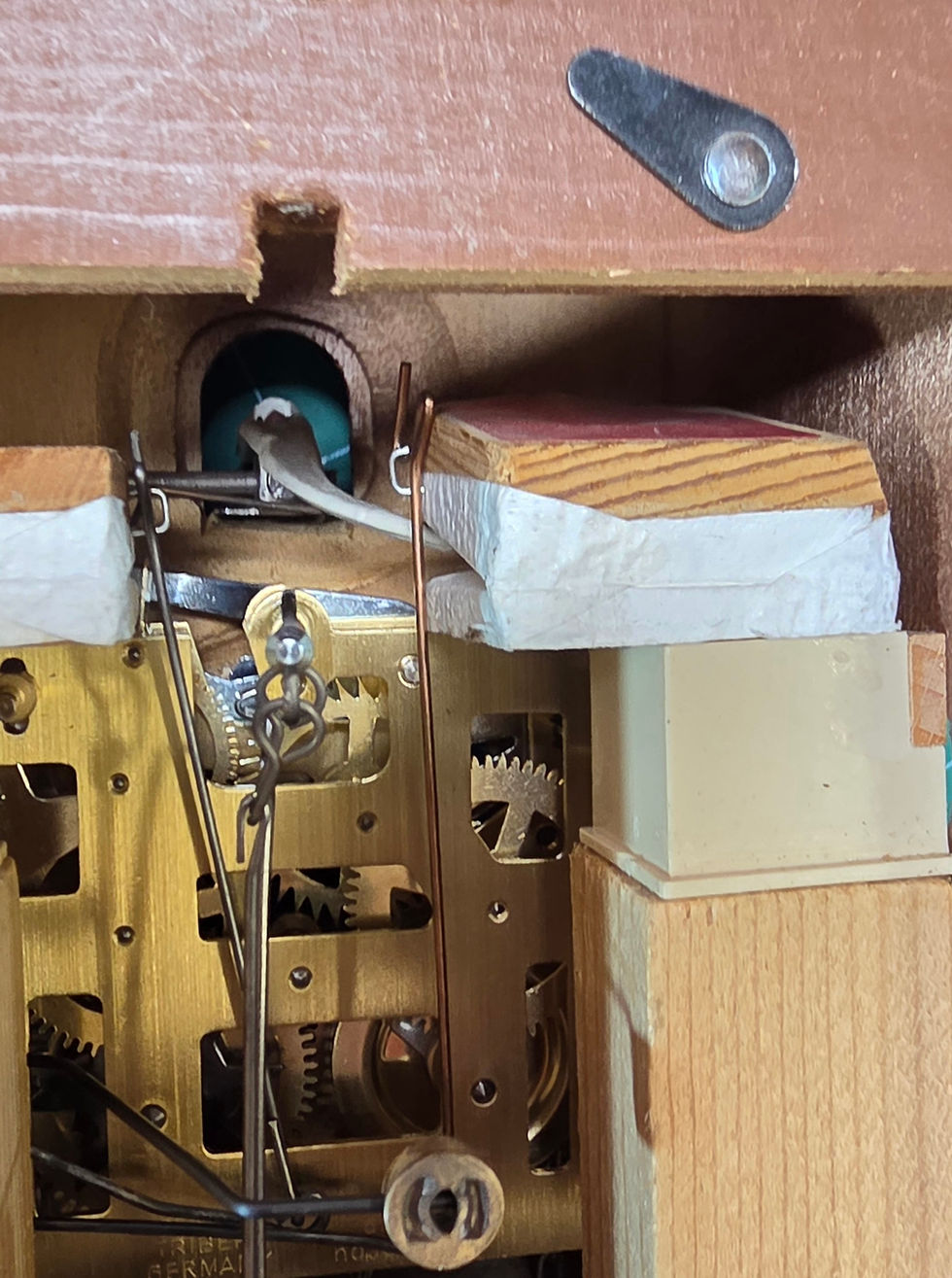
The internal mechanics of a dumpling eater clock rely on a precise extension of standard Black Forest striking movements, using a complex system of cams, wire linkages, and levers to synchronise the animation flawlessly with the passing of time.
The Dual-Drive System
To power both the timekeeping and the heavy physical movement of the automaton, these
clocks utilize a split train layout within robust brass plates:
The Time Train: Drives the hands and the pendulum. A small lever extending from the
escapement verge directly hooks into the back of the eyes. As the pendulum
swings side-to-side, it constantly pulls the wire, causing the eyes to roll (Augenwender) with
every single tick of the clock.
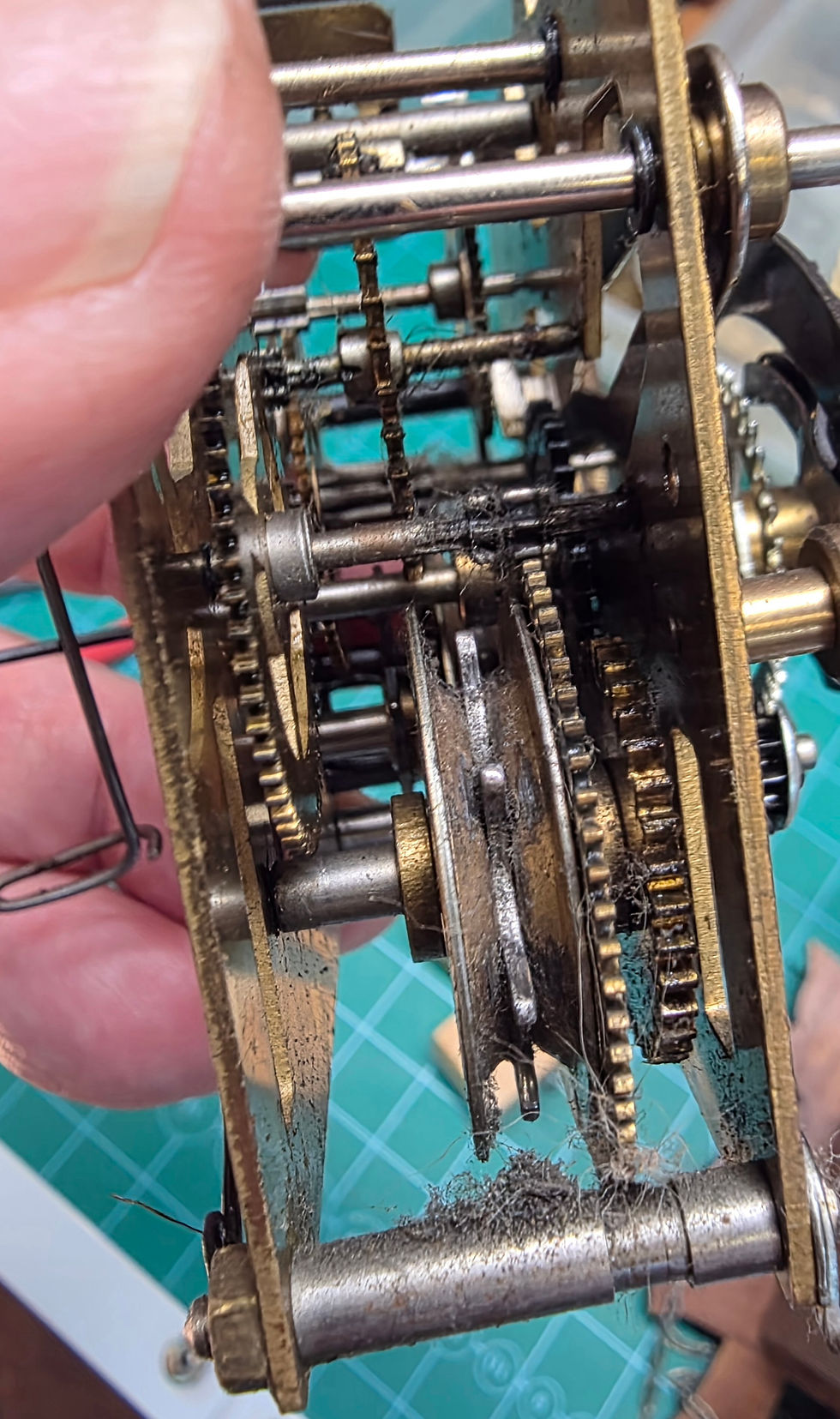
The Strike Train: Powers the actual eating sequence. Because lifting a heavy wooden arm
and opening a jaw requires significant energy, the animation does not run off the
timekeeping side. Instead, it hitches a ride on the striking mechanism, powered by its
own dedicated weight or spring.
The Kinetic Step-by-Step Sequence
When the clock reaches the hour, the internal counting wheel (either a countwheel or a rack-
and-snail system) releases the strike train. This kicks off an intricate mechanical chain reaction:
1. The Lifter Cam: Mounted directly onto the arbor (axle) of the striking train main gear is a specialised wheel featuring raised pins or a heart-shaped cam.
2. The Rocker Shaft: As this gear rotates to strike the hour, the cam pushes against a heavy
brass lever. This lever rotates a vertical iron wire or rocker shaft that travels straight up
through the top of the clock case into the hollow body of the carved figure.
3. The Coordinated Arm Lift: Inside the figure, the rotating shaft pulls a string or wire
connected to the pivot point of the shoulder. This forces the arm upward, raising the fork
and dumpling toward the mouth.
4. The Drop-Jaw & Release: The jaw is counterweighted or spring-loaded to stay closed. Just
as the arm reaches its highest point, a secondary tab or notch on the internal vertical wire
hits the lower mechanism of the jaw, forcing the mouth wide open.
5. The Swallow Reset: As the gear continues its rotation, the lever slips off the high point
of the cam. Gravity or a small internal spring quickly pulls the arm back down to the plate,
while the jaw snaps shut, simulating a bite and swallow. This sequence resets and repeats
exactly once for every chime.
4. Industrial Era and Modern Legacy
By the 1870s and 1890s, high-end firms like Winterhalder & Hofmeier and Gordian Hettich &
Son were manufacturing luxury 8-day spring-driven and weight-driven dumpling eaters for
export worldwide. However, because the hand-carving and intricate lever-and-wire linkages
required immense labor compared to standard cuckoo clocks, production volumes remained
low. As mass production swept the Black Forest toward the turn of the 20th century, these
complicated novelty pieces faded from standard catalogs.
Today, original 19th-century dumpling eater clocks are incredibly scarce and highly coveted by horological collectors, often fetching steep prices at boutique auction houses.
The legacy of the clock is kept alive primarily by the traditional Black Forest manufacturer Rombach & Haas (Romba). They remain the only modern workshop that still produces authentic, hand-crafted replicas of these early 19th-century mechanical masterworks.
Comments